
What Does the One Big Beautiful Bill Act Mean for Your Business?
Understand the tax changes, planning opportunities and business decisions that may deserve your attention in 2026.
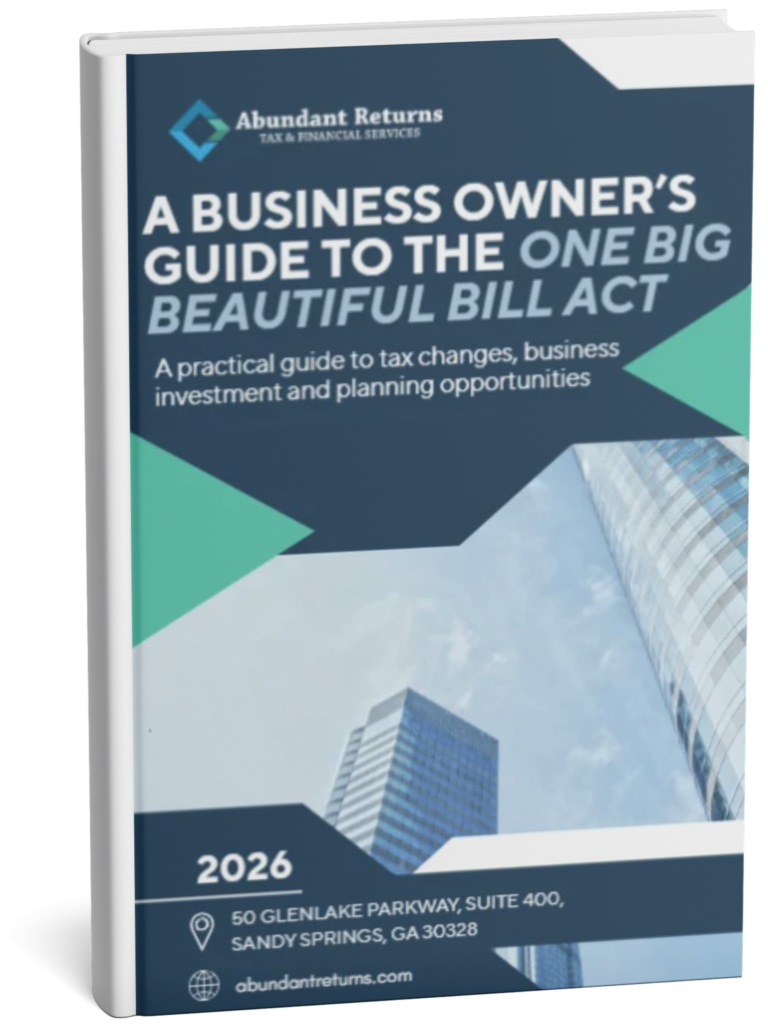
Download A Business Owner’s Guide to the One Big Beautiful Bill Act from Abundant Returns Tax & Financial Services for a practical overview of the provisions and planning questions business owners should be discussing with their tax advisors.
Understand Key Tax Changes
Identify Planning Opportunities
Make Informed Business Decisions
Prepare for 2026 and Beyond
Inside the Guide, You'll Learn:
- How 100% bonus depreciation could affect qualifying equipment and property investments
- What business owners should consider when evaluating Section 179
- How changes involving domestic R&D expenses may affect innovation and product development
- Why financing and business interest deductions deserve another look
- Potential considerations for pass-through business owners
- How employee benefits may factor into tax planning
- Questions to consider when planning expansion, automation, succession or ownership changes
- What information to bring to your next tax-planning conversation
Don’t wait until tax filing season. Many OBBBA opportunities are tied to business decisions made during the year.
PLANNING A MAJOR BUSINESS PURCHASE?
Timing May Matter.
If your company is considering new machinery, technology, business vehicles, automation equipment or certain building improvements, understanding the tax treatment before the purchase can help you evaluate the investment more completely.
Depending on eligibility, accelerated depreciation may allow a business to deduct a larger portion, or potentially the full eligible cost, of qualifying property in the year it is placed in service. That can reduce taxable income sooner and potentially improve near-term cash flow.
But the goal isn’t to make purchases simply for a deduction.
It’s to understand whether current tax rules could change the financial impact of investments your business already needs to make.
R&D ISN'T JUST FOR TECHNOLOGY COMPANIES
Innovation Can Create Opportunity
Your business may be conducting research and development activities without describing them as “R&D.”
The guide identifies potential activities including:
- Developing new products
- Improving manufacturing processes
- Engineering
- Prototyping
- Testing
- Software development
- Product design
- Technical experimentation
Manufacturers, engineering companies, software firms and other businesses may conduct qualifying activities through their normal product or process development work.
Understanding and properly tracking those activities can be an important part of your overall tax strategy.
What is the One Big Beautiful Bill Act?
The OBBBA is a federal tax law that changes how businesses may deduct investments, manage expenses and plan for growth.
Will the One Big Beautiful Bill Act automatically lower my business taxes?
No. The impact depends on factors including your business structure, income, investments, expenses and eligibility for specific provisions.
Should I buy equipment just to take advantage of a tax deduction?
Generally, no. Tax benefits should support a sound business investment rather than be the reason for making an unnecessary purchase.
Does R&D only apply to technology companies?
No. Potential qualifying activities can occur in manufacturing, engineering, software, product development and other industries.
When should business owners begin planning for OBBBA?
As early as possible, especially when significant purchases, investments or other major business changes are anticipated.
Could OBBBA Change the Way You Plan for 2026 and Beyond?
The decisions you make about equipment, growth, financing, innovation and ownership can have tax consequences long before your return is filed.
TAKE THE NEXT STEP
Could OBBBA Change the Way You Plan for 2026 and Beyond?
Download A Business Owner’s Guide to the One Big Beautiful Bill Act to understand the questions worth asking now and prepare for a more productive conversation with your tax advisor.